
Why user traceability and network security matter
Your WiFi works perfectly. But would you be able to identify who was connected if a security incident occurred?
Every day, thousands of users connect to WiFi networks in hotels, businesses, public venues, and commercial establishments across Spain.
But here’s a question worth asking: if illegal activity were traced back to your public IP address tomorrow, would you have the connection logs needed to investigate who was using your network?
Providing Internet access is easy. Ensuring user traceability, protecting personal data, and maintaining appropriate connection records is a different challenge.
What does Spanish Law require?
In Spain, Law 25/2007 of 18 October regulates the retention of certain electronic communications data. Article 5 establishes a general retention period of 12 months for operators subject to the law. However, these obligations do not automatically apply to every business offering guest WiFi. Their applicability depends on the type of operator and the services provided.
At the same time, the General Data Protection Regulation (GDPR) requires organizations to process personal data lawfully, securely, and only for as long as necessary.
Spain’s National Security Framework (ENS), established by Royal Decree 311/2022, also includes requirements for recording user activities and investigating security incidents within its scope.
The question is: does your current WiFi infrastructure provide the information you may need?
Why WiFi connection logs matter
Imagine hundreds of guests sharing the same public IP address in a hotel. If suspicious activity is detected, how can the network operator determine which user or device was connected at that time?
Without reliable authentication and session records, investigating the incident becomes considerably more difficult.
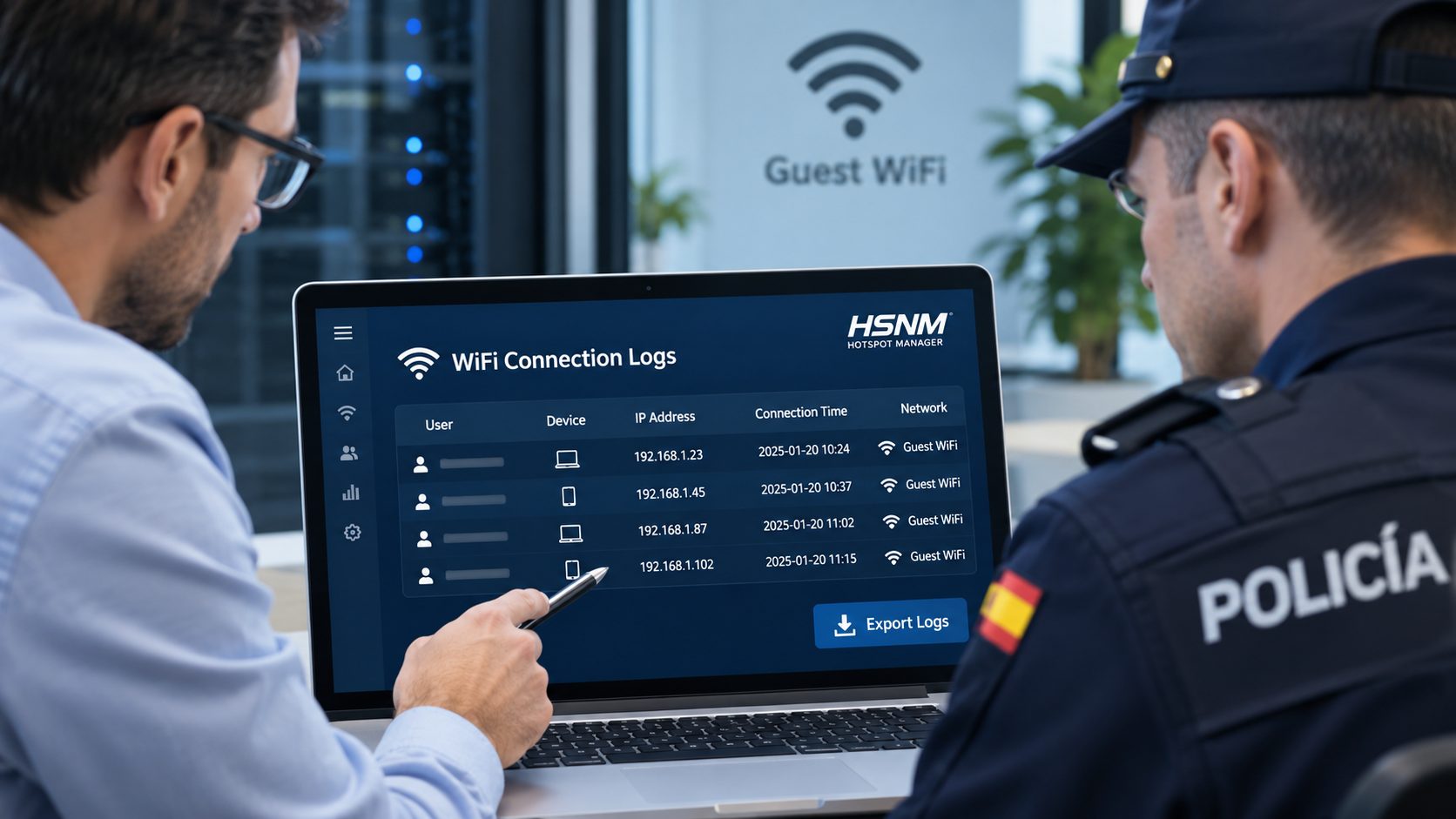
Connection logs provide essential information about users, devices, assigned IP addresses, connection times, and the networks accessed. When legally required, these records must be made available to the competent law enforcement authorities, who are responsible for examining them and conducting any necessary investigations.
But keeping connection logs is only part of the responsibility. Prevention is equally important.
Securing a WiFi network also means protecting users from potential online threats. With solutions such as HSNM Family DNS, network operators can apply DNS filtering policies to block access to malicious, phishing, and inappropriate websites, helping create a safer browsing environment.
By combining connection logging with proactive DNS filtering and access control, HSNM Hotspot Manager helps operators address both traceability requirements and everyday network security challenges.
How HSNM Hotspot Manager can help
And when a useful tool already exists, companies have a choice: wait until its use becomes an obligation, or make it available because they believe it provides value to their customers and their families.
For ISPs, this can mean offering more than connectivity.
For System Integrators, it can mean designing networks that consider not only performance and security, but also the people who will actually use them. For parents, it means having another tool available to help create a safer digital environment for their children. Not because a law says they must have it. Because the technology already allows us to offer it.
HSNM already makes this possible
With HSNM Hotspot Manager, different access policies can be provided using the same WiFi infrastructure. Family DNS can be used to restrict specific content categories, while custom blacklists and whitelists provide additional control where required. Categories are updated every day.
With HSNM, network operators can:
- ➜Record user sessions and connection details.
- ➜Manage authentication through multiple login methods.
- ➜Enhance network security with Family DNS, filtering access to malicious, phishing, and inappropriate websites.
- ➜Configure DNS filtering policies for individual networks.
- ➜Export connection logs for external storage and analysis.
HSNM allows network operators to export connection logs for external archiving and define their own retention periods according to their operational needs and applicable legal requirements.
Are you prepared if something goes wrong?
A reliable WiFi connection is important, but knowing who accessed your network and having the records needed to investigate an incident is just as essential.
Don’t wait for a security incident to discover what’s missing from your WiFi infrastructure.
Take control of your network with HSNM Hotspot Manager.